
For Research Use Only (RUO): This content is intended strictly for educational and laboratory research purposes. Products referenced on this site are not for diagnostic, therapeutic, or human/animal use.
Peptide CoA Analysis: What Is a Certificate of Analysis?
Peptide CoA analysis is a critical skill for any RUO researcher. A Certificate of Analysis (CoA) is the primary quality document supplied with every professionally manufactured RUO peptide. It provides a verified record of the compound’s identity, purity, and analytical test results from the batch that was shipped to the researcher.
Specifically, knowing how to read a peptide CoA is a core competency for any researcher, procurement officer, or quality assurance team working with RUO materials. A CoA that is missing data, inconsistent, or poorly formatted is a warning sign that should prompt further inquiry before the material is used in any research workflow.
Why the CoA Matters in RUO Research
Importantly, in RUO laboratory settings, there is no regulatory body verifying the quality of purchased peptides at the point of use. The responsibility falls entirely on the researcher and their institution. The CoA is your primary — and often only — evidence that a peptide meets the specifications required for your study.
Therefore, using a peptide without reviewing its CoA introduces unquantifiable variability into your results. A compound that appears visually identical to a verified lot may differ significantly in purity, sequence accuracy, or contamination profile.
For a broader understanding of purity metrics, see: How Peptide Purity Is Measured: HPLC, MS, and RUO Quality Specifications
How to Read a Peptide CoA Analysis: Section by Section
In practice, a properly formatted RUO peptide CoA contains several distinct sections. Here is what each one means and what to look for.
1. Compound Identity
First, this section identifies the peptide. It should include the full compound name, the amino acid sequence written in single-letter or three-letter code (e.g., GEPPPGKPADDAGLV for BPC-157), and the catalog or lot number. Verify that the sequence on the CoA matches exactly what you ordered. A single amino acid substitution changes the compound entirely.
2. Molecular Formula and Molecular Weight
Additionally, the molecular formula (e.g., C₆₂H₉₈N₁₆O₂₂) and molecular weight in Daltons should be listed for every peptide. These values should be consistent with publicly available database entries for the compound. Cross-reference these against PubChem or UniProt when working with well-characterized sequences.
3. HPLC Purity Data
Specifically, High-Performance Liquid Chromatography (HPLC) is the standard method for measuring peptide purity. The CoA should list a purity percentage — typically expressed as “≥95%,” “≥98%,” or “≥99%.” This value represents the proportion of the sample that is the target compound versus impurities.
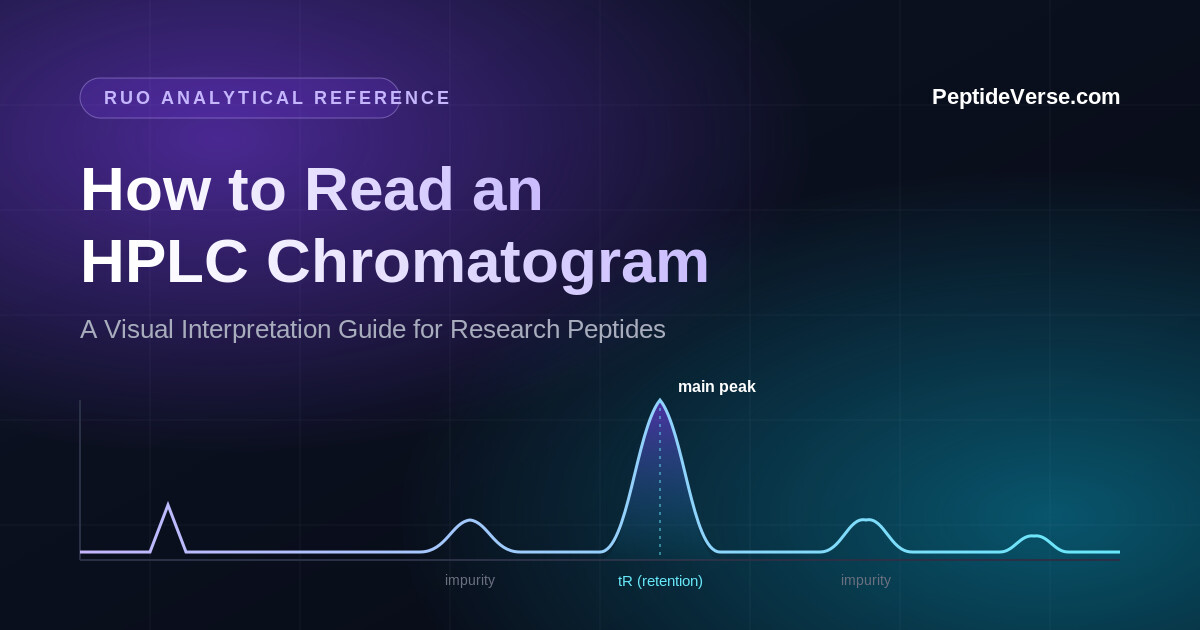
Furthermore, the CoA should also include a chromatogram trace showing the HPLC peaks. A single dominant peak with minimal shoulder peaks or baseline noise indicates high purity. Multiple peaks of comparable height indicate significant contamination or synthesis byproducts.
For a detailed guide to purity grades, see: Peptide Purity Grades Explained: What 95%, 98%, and 99%+ Mean for RUO Research
4. Mass Spectrometry (MS) Results
Consequently, mass spectrometry confirms the peptide’s identity by measuring its molecular mass. The CoA should list the observed mass from MS analysis and the theoretical mass calculated from the sequence. These two values should agree within the instrument’s margin of tolerance (typically ±1 Da for standard instruments).
Therefore, a significant discrepancy between observed and theoretical mass indicates a synthesis error, missing amino acid, or unexpected modification. This is a disqualifying finding — the lot should not be used.
5. Lot or Batch Number
Moreover, the lot number ties the CoA to a specific production batch. This is critical for traceability. If an issue is discovered with a research result, the lot number allows the problem to be traced back to the specific material used. Always record lot numbers in your laboratory notebook alongside experiment records.
6. Storage Conditions
The CoA should specify recommended storage conditions — typically -20°C for most lyophilized peptides, with notes for any compounds requiring special handling such as protection from light or oxygen. Follow these instructions exactly to maintain compound integrity.
For comprehensive storage guidance, see: Lyophilized Peptides: Storage, Handling, and Stability for RUO Research
7. RUO Statement
Every legitimate RUO peptide CoA must include a clear statement indicating that the material is for research use only and is not intended for diagnostic, therapeutic, or human/animal use. If this language is absent, do not use the material and contact the supplier for clarification.
Red Flags on a Peptide CoA
When reviewing how to read a peptide CoA, be alert to the following warning signs:
- No chromatogram trace: A purity percentage without a supporting HPLC trace is unverifiable — treat the claim with skepticism
- MS data not provided: Without mass spectrometry confirmation, peptide identity cannot be verified
- Observed mass does not match theoretical: This indicates a synthesis or modification error
- No lot number: Untraceable material creates significant audit and reproducibility risk
- No RUO statement: Required for all research-grade peptide documentation
- Vague or missing storage instructions: Indicates inadequate supplier quality controls
Accessing CoAs for PeptideVerse Products
All peptides sold by PeptideVerse include CoA documentation. You can access certificates for your specific lot on our dedicated CoA and SDS documentation page. If you require documentation for a specific lot not listed, contact our team directly.
External Scientific References
- PubChem – Peptide Molecular Data
- NCBI PubMed Central – Analytical Chemistry Literature
- UniProt – Protein and Sequence Database
Conclusion: Mastering Peptide CoA Analysis
Knowing how to read a peptide CoA is one of the most practical skills in RUO laboratory research. It empowers researchers to verify what they are working with before any experimental work begins, catch supplier errors before they contaminate a study, and maintain complete traceability across multi-lot research programs.
A strong CoA with a verified sequence, confirmed HPLC purity, matching MS data, a clear lot number, and an explicit RUO statement gives you confidence in your materials. Anything less than that warrants follow-up before use.
RUO Reminder: All peptides available at PeptideVerse are sold strictly for Research Use Only. They are not intended for human or animal administration, diagnostic use, or therapeutic application.