For Research Use Only (RUO): This content is intended strictly for educational and laboratory research purposes. Products referenced on this site are not for diagnostic, therapeutic, or human/animal use.
What Are Research Peptides? Research Peptides Explained
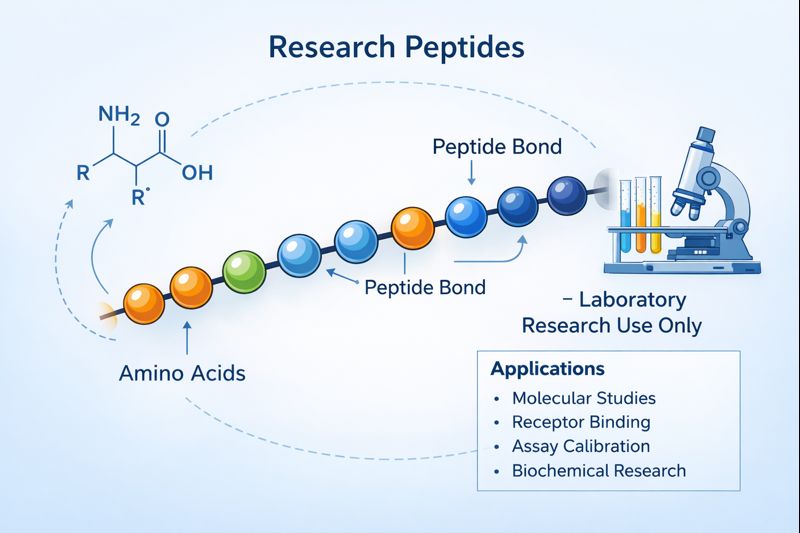
Research peptides explained: they are short chains of amino acids — typically between 2 and 50 residues in length — synthesized under controlled laboratory conditions and supplied for use in non-clinical scientific investigations. The term “research peptide” encompasses a wide range of compounds distinguished by their sequence, function, and intended application within the broader framework of RUO laboratory science.
Importantly, unlike pharmaceutical compounds, research peptides are not evaluated for safety or efficacy in clinical settings. Their value lies in their utility as research tools — enabling scientists to study receptor interactions, pathway dynamics, biochemical mechanisms, and molecular processes without the regulatory overhead associated with clinical-grade materials.
How Research Peptides Are Synthesized
Today, modern RUO research peptides researchers almost universally produce using solid-phase peptide synthesis (SPPS), a technique developed in the 1960s by R. Bruce Merrifield. SPPS builds the peptide chain one amino acid at a time on a solid resin support, with each amino acid being chemically coupled and then deprotected in a sequential process.
The advantages of SPPS for RUO production include:
- High degree of sequence control, enabling synthesis of specific target sequences
- Scalability from milligram to gram quantities
- Compatibility with unnatural amino acids and chemical modifications
- Ease of purification through HPLC following cleavage from the resin
Subsequently, after synthesis and cleavage from the resin, the crude peptide mixture undergoes purification — typically by reversed-phase HPLC — to achieve the target purity grade. The purified compound is then lyophilized (freeze-dried) and packaged for distribution.
How Research Peptides Are Tested
Therefore, quality testing distinguishes a professionally supplied RUO peptide from an undocumented compound. Research peptides explained within a quality assurance context require two primary analytical validations before release.
HPLC Purity Testing
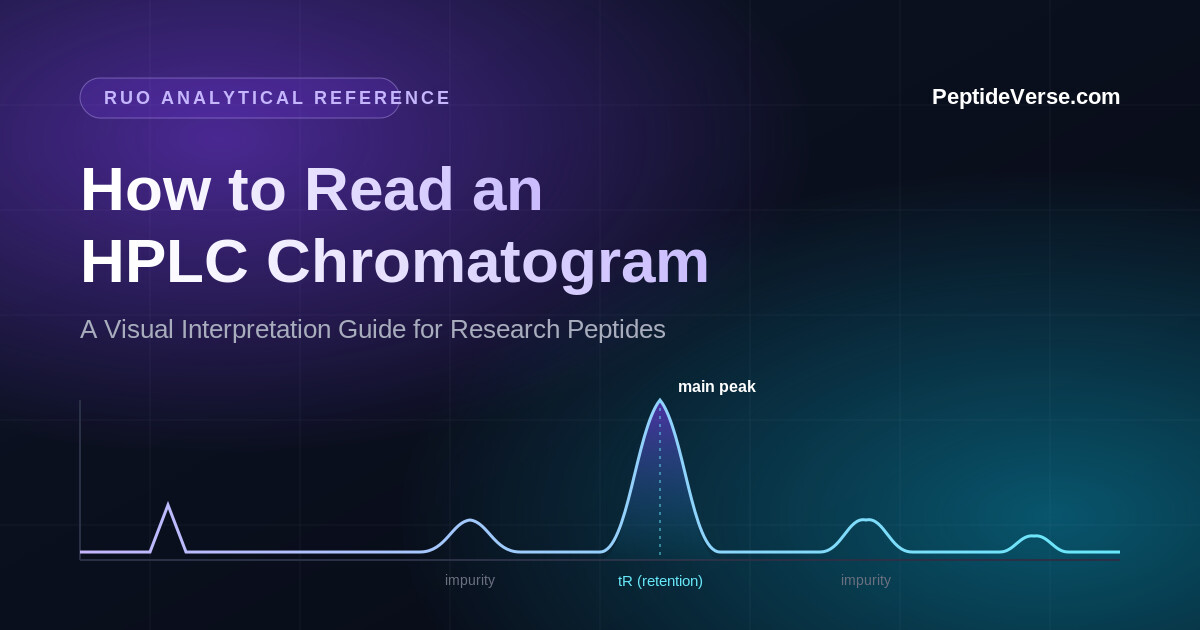
Specifically, High-Performance Liquid Chromatography confirms that the compound meets its specified purity grade — whether ≥95%, ≥98%, or ≥99%. The Certificate of Analysis includes a chromatogram trace from HPLC analysis as visual verification of the purity data. For more detail, see: How Peptide Purity Is Measured: HPLC, MS, and RUO Quality Specifications
Mass Spectrometry Identity Confirmation
Additionally, mass spectrometry confirms that the compound’s measured molecular weight matches the theoretical weight calculated from its amino acid sequence. A peptide that shows high HPLC purity but fails MS identity confirmation is either a different compound or contains a significant structural modification that must be investigated before use.
How Research Peptides Are Stored
Furthermore, storage conditions directly affect peptide stability. Research peptides explained in terms of storage requirements follow clear principles based on the peptide’s physical form and sensitivity:
- Lyophilized (dry powder): Most stable form — store at -20°C for routine use or -80°C for long-term archiving. Keep sealed and dry at all times
- Temperature sensitivity: Never store lyophilized peptides at room temperature — even short-term ambient exposure can initiate degradation in sensitive sequences
- Light sensitivity: Compounds containing Trp, Tyr, or Phe residues should be stored in amber or opaque containers away from UV light
For comprehensive storage protocols, see: Lyophilized Peptides: Storage, Handling, and Stability for RUO Research
RUO Compliance: The Regulatory Framework
In practice, the RUO classification governs how research peptides suppliers legally distribute, marketed, and used. Understanding this framework is essential for any laboratory working with synthetic peptide reagents.
What RUO Means
Consequently, Research-Use-Only materials researchers must not use them for diagnostic, therapeutic, or clinical applications. The RUO designation applies at the point of manufacture and sale — it is the supplier’s declaration that the compound is intended only for laboratory research.
Researcher Responsibility
The RUO classification places significant responsibility on the researcher and their institution. In the absence of regulatory oversight at the point of use, labs must maintain their own compliance through proper purchasing documentation, storage logs, handling protocols, and use restrictions. All personnel working with RUO materials should understand the compliance boundary and document their workflows accordingly.
For a full overview of what RUO means in practice, see: What Are Research-Use-Only (RUO) Peptides? A Complete Guide for Labs
Common Applications of Research Peptides in Laboratory Science
In summary, research peptides explained within the context of their laboratory applications reveal their diversity as scientific tools. Common applications include:
- Receptor binding and interaction studies: Using peptide ligands to characterize receptor pharmacology in non-clinical models
- Pathway modeling: Studying how specific peptide sequences modulate signaling cascades in cell-free or cell-based systems
- Assay development: Developing and validating analytical assays using peptides as standards or calibrators
- Structure-activity relationship (SAR) studies: Systematically varying peptide sequences to identify key residues for biological activity
- Biochemical education: Using characterized peptides in educational demonstrations within approved laboratory settings
How to Source Research Peptides for Your Lab
Selecting a peptide supplier is as important as selecting the compound itself. Key criteria for responsible sourcing include:
- HPLC and MS documentation provided with every lot
- Transparent RUO labeling on all products and documentation
- Accessible CoA and SDS database for verification
- Clear lot numbering for traceability
PeptideVerse provides analytically verified RUO peptides with complete documentation. Browse our full product catalog at our shop and access CoA documentation at our CoA page.
External Scientific References
- PubChem – Peptide Molecular Data
- NCBI PubMed Central – Peptide Synthesis and Research Literature
- UniProt – Amino Acid and Peptide Sequence Database
Conclusion: Research Peptides Explained for Your Lab
Research peptides explained in full context are sophisticated laboratory tools with well-defined quality, documentation, and compliance requirements. From their synthesis via SPPS to their analytical testing, storage, and application in non-clinical research settings, every stage of the research peptide lifecycle requires deliberate, protocol-driven management.
Understanding what research peptides are, how they are made, how their quality is verified, and how they must be used forms the foundation of responsible RUO laboratory practice.
RUO Reminder: All peptides available at PeptideVerse are sold strictly for Research Use Only. They are not intended for human or animal administration, diagnostic use, or therapeutic application.