For Research Use Only (RUO): This content is intended strictly for educational and laboratory research purposes. Products referenced on this site are not for diagnostic, therapeutic, or human/animal use.
Why Peptide Stability RUO Research Depends on Proper Storage
Peptide stability RUO research depends on understanding storage conditions. Proper peptide stability is among the most frequently overlooked variables in RUO laboratory research. A peptide that arrives at verified purity can degrade significantly if stored incorrectly — and unlike obvious equipment failures, stability-related degradation often produces no visible signs. The compound looks identical in the vial, but the research data becomes unreliable.
This guide explains what peptide stability studies evaluate, which storage conditions have the greatest impact on degradation, and how to implement best-practice protocols that protect your RUO peptide supply across the full duration of a research program.
What Are Peptide Stability Studies?
Peptide stability studies are systematic evaluations of how a peptide’s chemical integrity changes under defined conditions over time. They measure factors such as purity retention, structural modifications, aggregation behavior, and biological activity changes across varying temperatures, humidity levels, pH environments, and exposure conditions.
For RUO researchers, stability data from a supplier — when available — provides guidance on optimal storage conditions and expected shelf life. When supplier stability data is not available, researchers may need to design their own short-term stability assessments to establish confidence in the materials they are using.
Key Variables That Affect Peptide Stability
Understanding what degrades peptides allows researchers to design storage and handling protocols that systematically minimize each risk factor.
Temperature
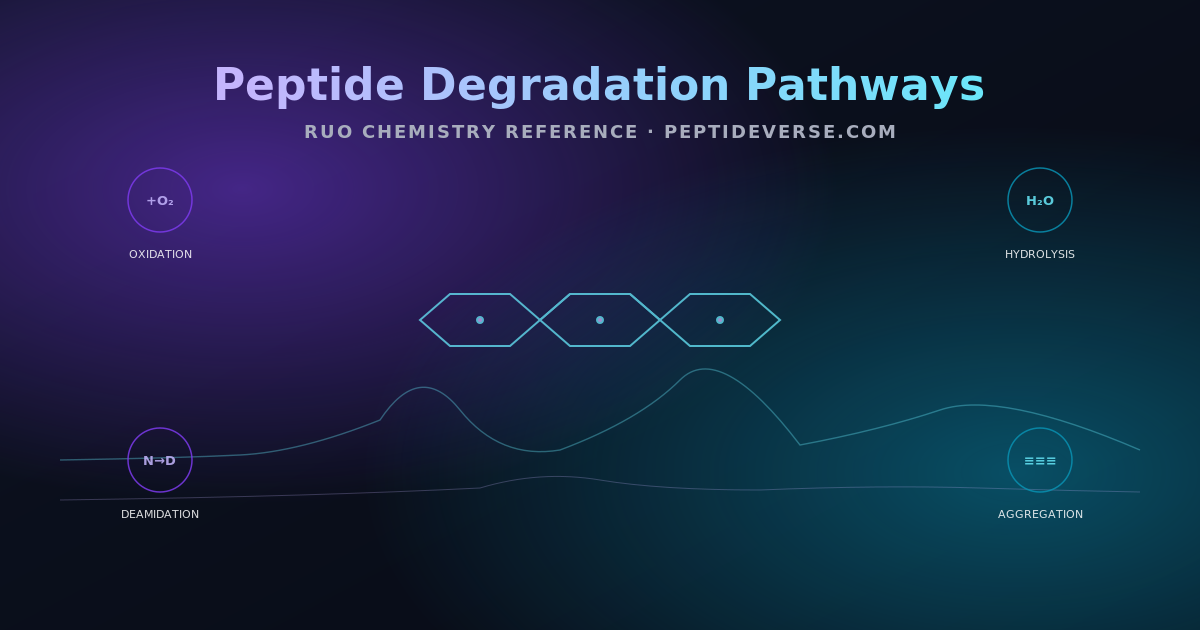
Temperature is the most critical variable in peptide stability storage conditions. Elevated temperatures accelerate nearly every chemical degradation pathway — including hydrolysis, oxidation, deamidation, and racemization. The relationship between temperature and degradation rate follows the Arrhenius equation: for most peptides, a 10°C increase in temperature approximately doubles the degradation rate.
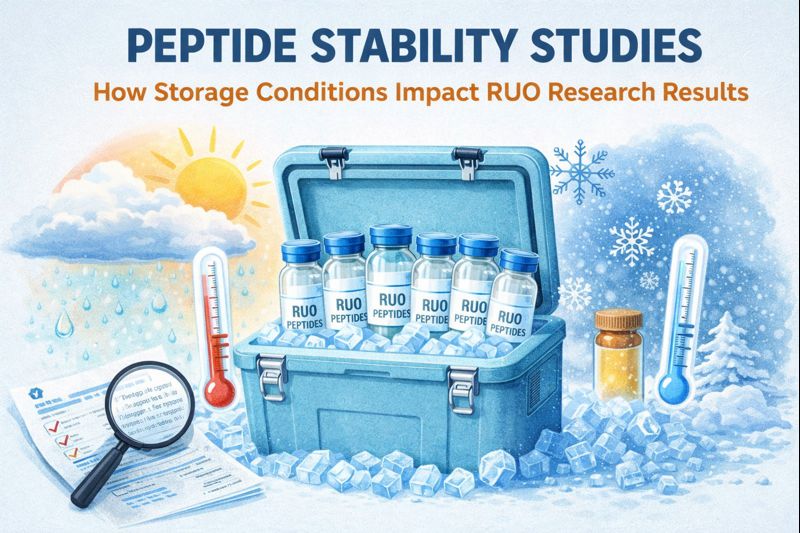
Most lyophilized RUO peptides should be stored at -20°C for routine use and at -80°C for long-term archiving. Room temperature storage — even short-term — should be avoided for all but the most stable compounds.
Moisture
Water is a primary driver of hydrolytic degradation. Lyophilized peptides are dried precisely to remove free water and slow this process. Any moisture introduced during storage or handling — from condensation, a poorly sealed vial, or high-humidity environments — reactivates hydrolysis and can rapidly compromise purity.
Protocols for managing moisture exposure are covered in detail in: Lyophilized Peptides: Storage, Handling, and Stability for RUO Research
Oxidation
Certain amino acid residues — particularly methionine, cysteine, and tryptophan — are susceptible to oxidation by atmospheric oxygen. Oxidized peptides may show altered behavior in assays that depend on specific side chain chemistry. Storage under inert gas or in oxygen-reduced environments can mitigate this risk for sensitive sequences.
Light Exposure
UV and visible light can induce photochemical degradation, particularly in peptides containing tryptophan, tyrosine, or phenylalanine. Amber or opaque storage vials should be used for light-sensitive compounds, and storage areas should be shielded from direct light sources.
pH
Peptides reconstituted in solution are sensitive to pH extremes. Acidic or basic conditions can accelerate hydrolysis of peptide bonds and deamidation of asparagine and glutamine residues. When working with peptide solutions, use buffered systems at physiologically neutral pH unless the experimental design requires otherwise.
Freeze-Thaw Cycling and Its Impact on Stability
Repeated freeze-thaw cycles are one of the most damaging practices in routine peptide handling. Each cycle introduces mechanical stress through ice crystal formation and causes incremental oxidative damage during the thaw phase. Research has demonstrated that even 3–5 freeze-thaw cycles can produce measurable purity loss in sensitive peptide sequences.
Best practices for peptide stability storage conditions to minimize freeze-thaw damage include:
- Pre-aliquoting the peptide supply into single-use portions before any dissolution
- Working exclusively from aliquots rather than repeatedly accessing a single bulk supply
- Using cryogenic tubes with tight-fitting caps to minimize headspace and moisture exchange during cycles
- Documenting the number of freeze-thaw cycles each aliquot has undergone
Sequence-Dependent Stability Differences
Different peptide sequences have inherently different stability profiles. Several sequence-specific factors influence degradation susceptibility:
Residue Composition
Peptides containing oxidation-prone residues (Met, Cys, Trp) or deamidation-prone residues (Asn, Gln) require more stringent storage conditions and may have shorter effective shelf lives than sequences composed of more stable amino acids.
Sequence Length
Longer peptides generally offer more potential degradation sites and may be less stable than short di- or tripeptides under identical conditions. This is reflected in the storage recommendations for longer research compounds such as Tesamorelin 5 mg, which require particular attention to storage protocol adherence.
Terminal Modifications
Unprotected N- and C-termini are more susceptible to exopeptidase activity and hydrolytic degradation than protected termini. Modified peptides may have different stability profiles from their unmodified counterparts.
Practical Storage Protocols for Common RUO Peptides
Based on peptide stability storage conditions data across common peptide types, the following protocols represent standard best practice for RUO research settings:
- Lyophilized powder, -20°C: Standard storage for most RUO peptides; suitable for use within 12–24 months of receipt when properly sealed
- Lyophilized powder, -80°C: Recommended for long-term archiving or sensitive sequences; extends usable shelf life significantly
- Post-dissolution aliquots, -20°C: Use within 7–30 days; minimize cycles; document each thaw
- Room temperature: Acceptable only during active use within a single session — never for storage
External Scientific References
Conclusion
Peptide stability storage conditions directly determine the reliability and longevity of your RUO research materials. Temperature, moisture, oxidation, light exposure, and freeze-thaw cycling are the primary degradation drivers — and each can be systematically managed through consistent, protocol-driven storage and handling practices.
Researchers who treat stability management as an active, documented part of their workflow are better positioned to produce reproducible data and maintain confidence in their materials across extended research programs.
Browse RUO peptides with documented stability specifications at PeptideVerse.
RUO Reminder: All peptides available at PeptideVerse are sold strictly for Research Use Only. They are not intended for human or animal administration, diagnostic use, or therapeutic application.